Showing posts with label shan. Show all posts

21 January 2010

Busy Dr. Jane Ferguson discusses Burmese film and Shan viewers
by Naw Liang (London, United Kingdom)


Mai soong kha!
I hope that everyone had a wonderful holiday season, wherever you are and whatever you might have done. For unforeseen reasons (what other kind are there?), I was unable to make my trek to Burma/Myanmar and the Shan State to continue my research: government workers and offices, like everyone else I am sure, grind to a halt over the holdiays, even in the UK. Oh well, there is always the spring...

For now, please enjoy this short post - with audio podcast too boot! - on eternally-active Dr. Ferguson and her latest lecture on Burmese cinema and Shan viewers.


The Burmese Film Industry and Shan Spectatorship
In March of last year (was it that long ago already?!), Ferguson gave an informative, insightful and interactive discussion entitled "
The Burmese Film Industry and Shan Spectatorship", which was based on research from her PhD thesis (Cornell, 2008) "Rocking in Shanland: Histories and Popular Culture Jams at the Thai-Burma Border". Held at something called the Brown Bag series for the Center of Southeast Asian Studies (CSEAS) at the University of Hawai'i at Manoa. Forever energetic, Ferguson's lecture was more open, engaging discussion than traditional seminar, with the UH students and staff actively questioned and discussing Ferguson's intriguing theories on and groundbreaking findings about Burma's long and vibrant history of indigenous film production. While she spent some time discussing ethnic and insurgency issues within Burma/Myanmar, including the decades-long insurgency, she chose to turn her attention to the consumption of popular culture. Ferguson highlighted a 'gap in research' as scholars and others prefer to focus on the overwhelming, in-your-face social and political problems within the country, unknowingly foresaking critical analysis and investigation of the daily lives of ethnic insurgents and their affiliates in the process. Drawing on her extensive ethnographic fieldwork (conducted within one Shan community), she revealed that Burmese culture, interestingly, remains symbolically relevant and richly meaningful for Shan despite the ongoing conflict; this may even be true amongst the most ardent Shan separatists. Very interesting research indeed.

Focusing her discussion of the Shan consumption of Burmese pop culture on
some popular genres of the Burmese motion picture industry, Ferguson discussed issues of viewership (she uses 'spectatorship') of such films in a village of Shan insurgents along the Thai-Burma border. The rest of her discussion (and the resulting and animated discussion) can be heard here (http://scholarspace.manoa.hawaii.edu/handle/10125/7210). Enjoy.

While they have yet to be published, interested parties should keep an eye open for two upcoming publications from Dr. Ferguson, including:
Rock Your
Religion: Shan Merit-making, Ritual and Stage-show Revelry at the Thai- Burma Border in Asian Legacies and Inscriptions of the State (her PhD these in book form); and
Revolutionary Scripts: Shan Insurgent Media Practice
at the Thai-Burma Border in Political Regimes and the Media in Asia: Continuities, Contradictions and Change.

Jom lii kha,

Naw Liang

13 December 2009

Reach for the sky: Shan paper airplanes
By Naw Liang
(London, UK)

Mai soong kha!
Well, we are finaly at the end of another year - Tai/Shan New Year 2014 was just celebrated a little over a month ago - and, as the year draws to an end, I find myself daydreaming, fiddling or just spaced out more than often. I guess I'm simply drained after another long (but fruitful) year of work, study, reading and writing. Time for a break....

More and more these days, I find myself up on the roof of our ofice building, scanning the horizon and thinking about things. Don't worry, there's nothing sinister about it. To be completely honest, though, I prefer the roof because it allows me to continue my (rather childish) hobby of making and testing paper airplanes, something that I have done longer than I can remember. If you ever find a uniquely designed paper airplane flying high over Finsbury Circus/Moorgate, that's probably mine, so cheer it along. Thanks.

Shan kids like paper airplanes too
It might sound strange, but Shan children are just like all other children. Of course they are. They ride bikes, play football (soccer), spend hours at chin lone (sepak takraw), play hide & seek and much more like children worldwide do. They also like paper airplanes, just like I did (do). But, it might be said, that no one likes (and is as skilled) at paper airplane flying than Mong Thongdee, a 12-year-old ethnic Shan who found himself in the news in late September this year after qualifying for and representing Thailand at the
4th Origami Plane Competition in Japan, the world championships for paper airplane piloting. In fact, Mong Thongdee was so skilled that he not only participated, but won a bronze (in the individual category) after previously winning gold - with a flight that lasted 11 seconds - for the Thai team. It appears that Mong knows his paper folding and flying, having won the national title - a pre-requisite to attending the world championships in Japan this year - in Bangkok with a flight of 12.5 seconds in 2008.

So Mong is a paper airplane whiz. Good for him. But, in all honesty, this wouldn't have been much of a story if it weren't for something out of Mong's control, beyond drafts, damp paper and sweaty hands that is. You see, Mong is, as stated above, an ethnic Shan living in Thailand. 'So what. There are many Shan living in Thailand," you might retort. Yes, very true. But Mong had one big problem prior to attending the international event in Japan. You see, despite having been born in Fang in 1987 and living his entire life in Thailand, the
fourth grade student at Ban Huay Sai Primary School (outside Chiang Mai, Thailand) isn't officially a Thai citizen. He is, in fact, one of many (tens of thousands it is assumed) illegal immigrants living in Thailand's northern regions.

Tai
but not Thai
Mong's case echoes many other Shan (and other ethnic minorities) living in Thailand. His parents,
Sai Nyunt and Nang Mo, are ethnic Shan who left their home in Kho Lan village, Shan State, Burma/Myanmar in 1995 to seek a better life in Thailand. They have been there ever since, working in a variety of industries to support their family, but never officially registering with the Thai state. Why didn't they (and many others)? Because to do so would surely mean a swift return to Burma/Myanmar, something that is not an option. So, many Shan, Karen and others don't, working on the sidelines or in the shadows, mingling only within their own circles and networks, happy to avoid all attention.

That would have continued for Mong and his family if it weren't for his airplane prowess - his family would have remained anonymous for as long as they could hold out, swelling the growing number of Shan that make Thailand - legally or not - their permanent home. While estimates vary wildly, of the total population of Tai Yai/Shan (approximately 6m), some 2m are believed to live in Thailand. For many others, day-to-day life unnoticed is the best they can hope for.

Drawing attention - spotlights or isolation
However, this wasn't in the cards for Mong. Because of his skills, Mong's story was thrust under the microscope: it wasn't until it was uncovered that he was an 'illegal resident' and almost denied his chance to compete Japan that his case (and many like him) came to light. When the Thai Ministry of the Interior decided to refuse his request for a travel document to visit Japan - having illegally alien Burmese migrant parents and no Thai identification card didn't help his cause - Mong too was labelled an illegal immigrant despite upbringing and life being entirely Thai to date. Most damaging of all, his birth in the kingdom appeared to have no meaning/significance at all and to anyone.

As the media swirled - there have been several major articles and exposes on the plight of ethnic minorities in Thailand and their citizenship/residency issues - Thai Prime Minister Abhisit Vejjajiva finally stepped in offered Mong a passport after meeting the boy in person in Bangkok. Mong and his family cheered the decision, and Mong himself said that Prime Minister Abhisit told him that they would meet again if he won first prize in Japan. It is hard to read the sentiment of that comment.

Homeward bound...

In the end, Mong was allowed to travel and excelled when he got the chance; I am sure his return visit to Bangkok, with his cheering parents by his side, was a pleasant end to this memorable time in his short life. He may even have become a minor local hero - I am sure his buddies at Ban Huay Sai Primary haven't askedhim a single question about his 'nationality', but have smothered him with requests on how to build the perfect paper airplane. And Mong has even said that, while he likes paper, he would prefer to become an airplane engineer in the future. I hope he gets the chance because he appears to have all the natural talent he needs. But, beyond the congratulations and praise, I wonder what is in store for him and his family, now well-known to everyone around them as 'illegals' in Thailand. More sinister, it has recently become known that Mong and his family are already on a repatriation list prepared by the Thai government of people to be return to Burma in February 2010. So, after 12 years in Thailand - the country of his birth - and representing (victoriously) the kingdom abroad, Mong and his family might be leaving in just a few short months.

With that in mind, I wonder if it had been better if he wasn't so hot with airplanes. Or, maybe, if he could just make them stay up in the air a little longer....

Jom lii kha,

Naw Liang

26 August 2009

New Book: Tai Lands and Thailand: Community and State in Southeast Asia by Andrew Walker (Editor)
by Naw Liang

Mai soong kha!
Well, things are picking up. Maybe it's the weather - London is already heading into autumn - or the idea, subconsciously, that 'school' is about to start that has me researching, reading and writing like crazy. That can only mean good things for All about Shan Studies - more 'talk' creates more debate and, ultimately, better ideas. At the moment, however, my head is firmly buried in a range of books that I have either come across by accident (and should have already known about really) or been informed of by Shan enthusiasts more dedicated than myself. Regardless of how we discover, every find is appreciated.

Before I dive into my pseudo-review, I should mention that I have yet to read the text in question, and my comments here are simply a condensation of more professional reviews - both official (in print or online) and through casual discussion with readers - by 'those in the know'. While it is only my everexpanding list of books to read, it may be some time before I get around to adding my own take on the text in question. Rest assured, I will add those thoughts when possible. My apologies for anyone who mistook my writings for the thoughts of someone who has read each tome in its entirety.


Text on the Tai: Tai Lands and Thailand by Andrew Walker
Posted originally in June 2009 on ANU's RSPAS site called 'New Mandala' (see here), Andrew Walker self-promotes the book, which seeks to highlight ongoing research (over the past six years) regarding 'Modern Tai Community' and a range of other issues dealing with the Tai and their status/existence within modern-day Thailand.

While a
full description of the book is provided on an independent website, my shortened take would be that the text helps to unravel a Tai universe that covers a great part of mainland Southeast Asia; in fact, it is much larger than many contend, as shown by the contributors to Tai lands and Thailand. Beyond cultural/influential spread, the book and its chapters focus on the 'commonly perceived meanings' of state and community, a fundamental theory of social/anthropological pursuits the world over. This ideas pits the concept of the modern-day country/nation (artificial and, largely Western, constructs anyway) against indigenous concepts of community as togetherness - state as administrative and commercial versus community as traditional, local knowledge and subsistence living. Central themes that contrast (as stated in the review) the different roles of state (to rule) versus community (to resist) as well as state as modern versus community as traditional also persist.

This book, however, seeks to challenge those preconceptions, using the Tai/Shan as their example. Examples of communities where the (administrative) state engages with the (indigenous/social) community are rife within the Tai and permeate throughout the economic (group - market; and individual - livelihood) and individual (aspirations) aspects of their lives. Furthermore, the contributors aim to challenge (and, in fact, decry) stereotypes shrouding traditional concepts of the village as well as modern perceptions of community (employment, economy and 'development'). While I will have to look further to see for myself, the undertones of anthropology of development are scintillating.
I am ready for my copy.

Most of all, the text must be praised for its bravery at taking on standardised theories of community versus state, a debate that will continue to rage (and heat up) as global societies shift and change. And that affects not only Shan living in remote Eastern Shan State, but everyone, everywhere. Walker's book is set to be challenge, inform and encourage thought about and studies on contemporary society in Southeast Asia for years to come.

While it has been some time since I read it (and my memory fades daily), I do hear some similar overtones to Andrew Turton's groundbreaking work Civility and Savagery: Social Identity in Tai States. Although a purely anthropological work, Turton's understanding of mainland Southeast Asia societies is impeccable, just as much as his skill at adeptly challenging current (then?) philosophies about Asian communities and the social identities that live within. Consider it.

Once again, thank you for visiting.

Naw Liang

09 April 2009

The 25th annual ASEASUK Conference
Swansea University (UK) (11-13 September 2009)

by Naw Liang (in Kyoto, Japan)


Mai soong kha!
Spring is finally upon us - the UK and Japan have been blooming with cheery blossoms so I can only assume that winter is over - and that means new growth and renewed energy. It also means that, as one university year comes to an end (in Europe and North America), another one waits in the wings or is just about to begin (Asia in particular). This is not only exciting for students, but important for scholars as now is the season of upcoming conference announcements, a time to see what ideas are rolling around the academic ether. I wonder what's on their minds today...

The 25th Annual ASEASUK Conference (11-13 September 2009 at Swansea University (UK)
The Association of South-East Asian Studies in the United Kingdom (more succinctly known as ASEASUK) (http://aseasuk.org.uk) is the UK's foremost academic community devoted to South-East Asian studies and research; it is a key associations of its kind in Europe (within EuroSEAS, the main European body) and is a growing authority worldwide. With an impressive pedigree - research, publications, presence and panel of experts - the ASEASUK holds annual conferences on SE Asian topics annually, except when EuroSEAS, which holds an event every three years, is organised. Previous conferences have brought together leading South-East Asian scholars from around the world to discuss, share and learn about this vibrant region and its people.

This year ASEASUK will be holding its 25th conference in Wales at Swansea University, which has a schedule that clearly illustrates the wide ranging topics possible, the growing interest and the increasing depth and wealth of experts in this South-East Asian academic fields.

While the deadline for papers has passed (1 April 2009), the following tentative schedule will give Shan and South-East Asian enthusiasts an idea of the depth and breadth of information to be presented at the conference in Swansea. Please remember that the following information is a rough overview of topics and their speakers to date; this information may change prior to the conference.

Note: While this is an exceptionally interesting, distinguished, varied and, well, long list, our attention should be drawn to the wonderful Dr. Susan Conway (see my previous post on her most recent work) and
Session 3: Theravada Buddhism and culture of the Tai of the Shan States and south-west China (see below), which will be a must see for any Shan enthusiast. Knowing Dr. Conway and her excellent research, this bodes to be a popular and insightful event.

For a full list of (and summaries on) the sessions schedule, including the always intriguing 'Emerging Scholars Panel', please visit the 25th annual ASEASUK conference's webpage on the ASEASUK website. See you in Swansea from 11-13 September 2009.

-------------
Session 3: Theravada Buddhism and culture of the Tai of the Shan States and south-west China
The Southeast Asian inland region of the Shan States, Sipsong Pan Na (south-west China), Lan Na (north Thailand) and Lan Xang (western Laos) is inhabited by Tai people who have a distinctive culture expressed in secular and religious scripts, literature, architecture, and arts and crafts. The Tai in this region practice a form of Theravada Buddhism distinguished by monastic literary traditions and rituals. This panel focuses on the religious and cultural traditions of the Tai of the Shan States and south-west China that in recent history have been under pressure as a result of extensive cross-border migration, major changes in social structure and loss of traditional monastic sponsorship.

Session contact is:
Susan Conway (SOAS) at susanmconway@ hotmail.com / sc66@soas.ac. uk
-------------

Until then,

Naw Liang

24 February 2009

Traditional Shan dance: Online lessons
by Naw Liang (London, UK and Kiev, Ukraine)

(with Sai Hsengb Pha and SCA_UK)
(Photo c/o SCA_UK. See more here)

Mai soong kha everyone!
It's been a long, busy period - too much work, too many responsibilities, too little free and 'me' time - and something needs to change. Taking a step away from the more serious, academic-like postings for a moment, I thought that it might be a nice change to do something fun, something physical and, of course, something Shan. The result? This mini-article on traditional Shan dance with an assortment of online video lessons from an avid group in Muse, obviously our friends in Muse (labelled Mern Mao in the video content) in upper Shan State.

Traditional Shan dance
Usually, I would spend the first paragraph (or two) imparting my (limited) knowledge of the topic at hand before launching into some recent research/investigation, a cross section of popular or common opinion(s) and possibly some general discussion. Then, to round it off, a short, hopefully logical, but thought provoking conclusion would close. That is, in a nutshell, the loose structure of All about Shan Studies.

At this time and with this topic, however, I am at a loss. I know nothing beyond some sparing observations of traditional Shan dance, and I have not spent any significant time researching it. Moreover, there are few (if any) sources discussing traditional Shan dance available. So, rather than spout off something ill-informed or, worse, wrong, this post services two purposes: to provide a starting point for anyone interested in and, more importantly, anyone knowledgeable about traditional Shan dance to start a discussion; and a chance to take a step away from the usual structure and provide a fun alternative to the norm. I hope you enjoy this.

The following is an excerpt from a message about the following traditional Shan dances. I have included a transliteration below (for those people, like myself, who have yet to perfect their Thai reading skills), but have not included a translation; my Thai skills, sadly, lack the proficiency required to render this adequately - they would be more harmful than helpful.

การฟ้อนไต แม้จะมีเพียง กลองก้นยาว, มอง(ฆ้อง) และ แส่ง(ฉาบ) เป็น เครื่องดนตรีหลักแต่ลวดลายการฟ้อน มีหลายท่า หลายจังหวะชมรมภาษาและวัฒนธรรมไทใหญ่ อ.น้ำคำ จ.หมู่เจ รัฐฉานเหนือได้จัดทำ วิดิโอ การฟ้อนไตเบื้องต้น (เหง้าฮากตางก้าไต)สำหรับผู้ต้องการฝึก และให้ผู้ชมสามารถดูออกว่า ช่างฟ้อน กำลังฟ้อนท่าอะไรอยู่

And here is my Thai transliteration. Apologies for any mistakes.
gaan fón dtai máe jà mee piang glong gôn yaao , mong ( kóng ) láe sàeng ( chàap ) bpen krêuang don-dtree làk dtàe lûat laai gaan fón mee lăai tâa lăai jang-wà chom rom paa-săa láe wát-tá-ná-tam tai yài or náam kam jor mòo jày rát chăan nĕua dâai jàt tam wí-dì oh gaan fón dtai bêua ง dtôn ( hăy ngáa hâak-dtaa ngá-gâa dtai ) săm-ràp pôo dtông gaan fèuk láe hâi pôo chom săa-mâat doo òk wâa châang fón gam-lang fón tâa à-rai yòo

It's time
The following is the entire course (to date) provided by our enthusiastic and instructive dance group(s) in Muse, Shan State. The tiny links underneath are the original sites, given in the event that the 'Lesson' links fail. To start your traditional Shan dance course, click on the each Lesson heading and view the YouTube video. But, before that, make yourself some space, stretch and warm up and get ready to dance.

Lesson 1 - กล่าวแนะนำ
http://www.youtube.com/watch?v=zdZjBQ1nzNI&feature=related
Lesson 2 - ตางก้าปั่นก๋อง
http://www.youtube.com/watch?v=Lrv2Wy7aJlA&feature=PlayList&p=040422DCDFB90CAE&playnext=1&playnext_from=PL&index=1
Lesson 3 - างก้าปั่นก๋อง แบบใหม่
http://www.youtube.com/watch?v=fJmG9A_JPUc
Lesson 4 - ตางก้าต้งตั้กปี้น้อง (ทักทาย)
http://www.youtube.com/watch?v=ghteBGRArk0
Lesson 5 - ตางก้าเยิงนกฮ่างหลี
http://www.youtube.com/watch?v=4aJHNSoDe1A
Lesson 6 - ตางก้าลุยน้ำ (ว่ายน้ำ)
http://www.youtube.com/watch?v=cVghnswKnu4
Lesson 7 - ตางก้าลายแค้นมือ (ศิลปป้องกันตัว)
http://www.youtube.com/watch?v=C0AHoc1bbBg
Lesson 8 - ตางก้ารำวง
http://www.youtube.com/watch?v=4AEuynPs7D0
Lesson 9 - ตางก้าก๋องมองยาง
http://www.youtube.com/watch?v=IShi8WOzNcs
Lesson 10 - ตางก้าก๋องมองเซิง
http://www.youtube.com/watch?v=n4Hz4HFyNsk
Lesson 11 - ตางก้าปั่นก๋องเก่า/ใหม่
http://www.youtube.com/watch?v=DfTt9YRgZxw and
Lesson 12 - สรุป
http://www.youtube.com/watch?v=_J86M0n-yK8

Congratulations!
You are now well on your way to becoming a truly skilled traditional Shan dancer. Now, exercise done, time to get back to our 'brain work'...

Naw Liang

06 November 2008

A little political: Chinese New Year versus Shan National Day
by Naw Liang
London, UK and Helsinki, Finland.

Mai soong kha!

I might be cheating a bit with this mini-post, but timeliness is most important feature here.


So, possible guilty feelings of plagiarism aside, this post has come about due to the mounting news and excitement for the upcoming 2103 Shan New Year (28 November 2009). The buzz has reminded me of a news article I picked up last year by Saw Yan Naing about another Shan holiday - Shan National (or State) Day. The following is a short summary and minor expansion of the original, which can be read here.

Certain Shan holidays under scrutiny
While Shan National Day (2009 date unknown) and Chinese New Year (26 January 2009) won't fall on the same day as they did last year, their convergence on 7 February 2008 helped emphasise internal policies and scrutiny against the Shan people, their culture and festivities in Shan State and throughout Burma/Myanmar. The stark contrast between rapturous celebrations held by Burma's growing Chinese community throughout the country, including Shan State capital Taunggyi, and a blanket ban, in place since 2001, on festivities around Shan National Day would have been impossible to miss. The additional imbalance between banning Shan National Day and allowing Shan New Year celebrations in December in Shan State further obfuscates the issue.

Although I lack firsthand knowledge of the ban, it was aptly described/confirmed by Saw Yan Naing last year, who wrote that the Shan had been '...officially barred from publicly marking the event after a regime [sic] edict banned the festival...in 2001, apparently because it was worried about growing political awareness among the Shan." Furthermore, a witness added weight to these claims, stating that "no celebration of the Shan festival was being held there [and that] many Chinese residents were gathering to celebrate Chinese New Year."

Yet, despite increased press in 2008, I (like many others) know that this discrimination is not of character. And, despite the strong internal history of this Shan event, which commemorates the adoption of a Shan national flag and anthem on 7 February 1947, official bans continue this year and into the foreseeable future. Such is life for ethnic minorities in Burma/Myanmar.

But, bans only apply to those who follow them, and the Shan have continued, in the face of official warnings, to hold events throughout Shan State and Burma/Myanmar. As an example, some events, though smaller and more subdued, were held throughout Burma/Myanmar in 2008, including:

The Shan State was the venue small local gatherings as well as more politicised events, such as those held by the Shan State Army (South) at their headquarters in Loi Taileng; and

Yangon
was also witness to more subdued festivities, including the offering of alms to monks at a Shan monastery in Yangon's Mayangone Township as well as dance and music performances by famous Shan performers, including the now deceased Sai Htee Saing. Event organiser Nang Boe Seng added that the event, more a commemoration than a celebration, aimed to help the "...Shan people [remember their] culture, tradition and religious customs. We also want the young generation to love and uphold our culture.”

Bigger abroad isn't always the best
These Burma-based events, with the continuing determination of local promoters and supporters, are encouraging to say the least. But it is the fact that the majority of Shan National/State Day celebrations take place overseas (predominately in Yunnan (China) and Chiang Mai and Mae Hong Son (Northern Thailand) and away from the Shan State that takes centre stage, reviving feelings of disappointment and demoralisation. These feelings are much harder to recall.

Let's hope that, some day soon, Shan National/State Day can, along with a myriad of Shan celebrations, be cheered where they ought to be - at home in Shan State.

And, although it might be jumping the gun a bit, mai soong pii mai tai.

Naw Liang.

05 November 2008

The 2008 International Burma Studies Conference
at Northern Illinois University (USA) from 3-5 October 2008
by Naw Liang (London, UK)

Mai soong kha. Once again, I am playing catch-up. So, rather than another sentence or two of apologies, let's get straight into it. Enjoy.

Northern Illinois University's Burma Studies Center held its Eighth International Burma Studies Conference in early October, a momentous occasion for Burma and Burma-related academia worldwide. NIU was handpicked in 1986 by the Burma Studies Group of the Association for Asian Studies to be the US' national centre for scholarly work on Burma, and it has impressed ever since. With a stunning faculty and world-renowned collection of Burmese materials, the interrelationship that has developed between the Burma Studies Group and NIU is second to none.

This year's conference has, like previous years, exceeded the scope and depth of expertise from Burma-specific and Burma-related experts from a range of disciplines, including art history, linguistics, anthropology and religious studies to name, but a few. A quick view of this year's programme (see link here) reveals the rapid growth in investigation and research brought about by keen academia and interested parties worldwide; it is now so big that it is impossible to take it all in. This is a problem that, at least from All about Shan Studies' perspective, we are happy to have to deal with. Of particular interest to me and Shan Studies readers is the increasing expansion of 'Burma Studies' into Burma's ethnic minorities, especially the Shan. Below is a brief list of presentation abstracts made at the conference that were distinctly Shan:

A BOOK FOR THE DEAD: A SHAN BUDDHIST TRADITION BEING A MEANS FOR THE PRESERVATION OF THEIR CULTURAL IDENTITY by Jotika Khur-Yearn
BEING SHAN ON THE THAI SIDE OF THE BORDER: CONTINUITIES AND TRANSFORMATIONS IN SHAN CULTURE AND IDENTITY IN MAEHONGSON, THAILAND by Nicola Tannenbaum
WHAT DOES IT MEAN TO BE SHAN? SHIFTING ETHNIC MARKERS FOR SHAN IN NORTHERN THAILAND by Nancy Eberhardt
PORT POLITIES IN THE HILLS: SHAN STATES AND TRADE IN THE CHINA-BURMA (MYANMAR) BORDER REGION by Chit Hlaing (F.K. Lehman)
These name but a few of the intriguing and insightful papers presented at the conference. It is my hope that a volume will be in publication soon.

So, despite missing the conference outright, it is great to see that research and consideration for Burma and Shan Studies is not only continuing, but steadily growing. This is very encouraging.

Gyan cha tha ba seh.

Naw Liang

09 October 2008

The ‘First International’ Conference on Shan Studies 15-18 October 2009
Chulalongkorn University
Bangkok, Thailand
By Naw Liang
(with SCA-UK, BNI Online, S.H.A.N. and others' assistance)

Attention: My apologies for the 'boring layout' of this post. There have been some formatting problems with Blogger.com, particularly transferring completed posts from MS Word, and, as a result, this post could not be produced to my usual standards. I am working to correct the problem; your patience is appreciated.


Well, it is almost exactly year-to-the-day of my previous post, discussing the inaugural Shan Conference on Buddhism and Culture held at SOAS in London on 8-9 December 2007, that I am happy to announce the coming of another conference on Shan Studies. Although I am unsure if it can honestly and correctly be titled ‘the first’ of its kind (the SOAS event was international, covering a range of professional Shan cultural research and attended by an impressive number of renowned Shan scholars), the purpose of this blog is not to critique the minute, but to promote Shan Studies on the whole.

That said, I am excited to announce that Thailand's prestigious Chulalongkorn University, its Institutes of Asian Studies (IAS) and Thai Studies, in conjunction with the Euro-Burma Office, are organising its First International Conference on Shan Studies (ICSS) to be held in Bangkok from 15-18 October 2009.


Background
The International Conference on Shan Studies is the fourth in a series of academic events by Chulalongkorn University’s Institute of Asian Studies focus on ethnic minorities in Burma: the Arakan History Workshop (2005) (see a paper presented here), the Rohingya Consultation (2006) (view papers here)and the Mon History Conference (2007) (see news of post-conference publication here). Each event built significant support, both within the respective communities and throughout their worldwide academic networks, helping to promote greater exposure and knowledge sharing. Great things are also expected for the Shan.

So far, high hopes have brought promising results. The conference already has the support of Thailand’s considerable Shan community: two of Thailand’s largest Shan community groups are co-managing the event, namely the Chiangmai-based Shan Literature and Culture Society, which is led by Saengmuang Mangkorn (youngest son of the late Shan resistance leader Sao Noi (1927-96), while Bangkok’s significant Shan community will be represented by General Phon Wanakamon, a retired Thai general of Shan origin, who leads their group.

Furthermore, the conference has been a buzzword amongst Shan internet and other circles for nearly a year, even before it was officially announced. Things bode well for mid-October.

The event: details
The International Conference on Shan Studies (ICSS) seeks to bring Shan scholars from around the world to Bangkok from 15-18 October to discuss a range of issues, while sharing their extensive knowledge and discoveries. Although academic panels are set to take centre stage, the key element of the conference is to promote cooperation amongst Shan scholars, researchers, enthusiasts and, most of all, people to bring about better collaboration and understanding in the future. In addition to the academic discussions, attendees will be able to view performances (classical dance and orchestral) as well as wander through significant exhibitions of Shan artefacts and artworks. Other events scheduled include a well-known historical short play Chao Ying Saenwi (Princess of Hsenwi) at the Chulalongkorn Auditorium.

Controversy: auspicious timing
There has been some controversy over the timing of the event. While the Shan community had originally suggested holding the conference during the Shan New Year (which would fall in November of 2009), the IAS has, instead, scheduled the event for October when classes are not in session. This seems a odd to me as, being a Shan event, wouldn’t it be auspicious (not to mention incredibly convenient) to hold the event during the annual celebration, thereby allowing most Shans in Bangkok (and nearby) to participate? "We have to find a way to deal with the congestion inside the campus first before we can come out with a definite date," Dr Sunait Chutintaranond, Director of the Institute of Asian Studies was quoted as saying.
Hmmm, I wonder.

Dear Scholar: A call for papers

The following information as received from an outside source. Apologies for any errors.

The organisers invite papers on all aspects of Shan Studies, including, anthropology, architecture, art history, environment, gender, history, literature, linguistics, music, performing arts, popular culture, religions and traditional medicine. Each contributor will have approximately 30 minutes for presentation. The languages to be used in the conference will be English and Thai.

A selection of the papers presented will be published in an edited volume within a year after the conference. The paper should be submitted by 1 September 2009. The paper should not exceed 10,000 words and it should include appropriate bibliography and citations.

Abstract submissions
An abstract of not more than 300 words (using 1” margins on all sides, 12pt font size and submitted as attachments in MS Word or pdf format) should be sent to the conference organisers by 28 February 2009. Abstracts can be sent via email to: shan.studies@yahoo.com or shanstudies@chula.ac.th. Key information - the title of the paper, the name(s) of the author(s), the affiliation of author(s) and contact details - must be included.

Upon receipt of any submissions and discussion, the conference organizers will decide which speakers will present at the event and contact the author(s) selected. Furthermore, all abstracts submitted in time will be published in an abstract booklet to be distributed during the conference. Finally, the conference organizers reserve the right to solicit papers, if necessary, from individuals who did not submit abstracts.

For abstract submissions, additional information or any inquiries, please contact:

Mrs. Charunee Lucktong
Institute of Asian Studies, Chulalongkorn University
7th Floor, Prachadhipok-Rambhai Barni Building,
Phyathai Road, Pathumwan, Bangkok 10330
THAILAND
Tel: +662 218 7463-4
Fax: +662 255 1124
Email: charunee.l@chula.ac.th

Mai soong kha everyone,

Naw Liang

10 May 2008

Shan Tattoos – Insight into ink and body art (Part II)
By Naw Liang

(in London, UK)

Mai soong kha!
As promised, this is the second and final section of my limited research on Shan tattoos. And, as before, I would be grateful for any further insights and opinions on this fascinating and core act of Shan culture, both for study and general interest. Your suggestions and comments are appreciated.

Note: Much of the information provided here was found through public sources (academic articles, books and journals and internet research) with additional comments and corrections from events during field visits to eastern Shan State (Mong Yawn, Mongtoon and Mongkok) in 2003 and 2006.

Photo credit: The photo of the monk having his head tattooed (above) was originally published by Brent T. Madison in a February article of The Irrawaddy entitled 'Tattoo not Taboo' by David Paquette.

Shan tattoos: a recap
As mentioned in the March 2008 posting, tattoos are a crucial part of Shan culture, particularly for men, as they are known largely for their spiritual power – they are thought to bring the bearer prosperity; conquer evil spirits; extend one’s life; and even protect against gunshots, knives and other weapons. A tattoo in these circumstances and with this mindset is much more than body art: it is a life force.

The ‘power’ that emanates from Shan tattoos is believed to come from a variety of sources, including the tattoo image; the method by which the tattoo is produced; the tattooist (often called spirit doctor) and the spell that he delivers by blowing on the tattoo and the Shan characters or script, which many believe cannot be read by spirits. However, even during such a spiritually-charged event, a fundamental measurement of the tattoo’s power is the money invested, with the most expensive and difficult tattoos always bringing greater honour, power, position, protection and wisdom.

The professional - the tattooist
The tattooist (or spirit doctor)* was traditionally, though less so in modern times, a travelling herbal medicine man who visited outlying villages during the cool season, usually lodging at monasteries. Spirit doctors chose this time for tattooing especially: the cool season, while traditionally a down-time with little work for the men, providing the ideal opportunity for spiritual pursuits, including tattoos. Furthermore, the cool season was often a time for reflection by many villagers with the temple at the heart of this activity.

* I used tattooist and spirit doctor interchangeably throughout this article.

The place - the mandat**
Although variations exist between the type of structure, the place (within the local Buddhist temple or monastery grounds) where men were tattooed was always the same: a mandat (special structure only erected in the temple grounds) would be set up in an auspicious corner of the monastery, followed by the recitation of sutras and a blessing of the ground with sacred water. The mandat, despite style and size, always follow the same basic structure and are built in the same regimented way. Following the site selection and ritual blessing, the spirit doctor and any assistants would lay down a thick layer of clean and well-watered sand before erecting the cloth roof (which is always fringed with illustrations of the eight planets) and walls, which are constructed from blankets and fenced off by slats of woven bamboo. Next, the fresh and watered sand floor would be covered with banana leaves, mostly to produce a pleasant aroma, before being covered with a blanket. The mandat is then decorated with important articles, including: an image of the Buddha; a range of different pots of ink; a surgery-like layout of tattooing needles; any number of vases with fresh flowers; and, finally, a bowl of sandal wood paste. One of the most interesting aspects of the construction of the mandat is a rope, which is tied inside the structure to act as a clothesline for the tattooed man’s waistcloth: this rope is thought to be made traditionally by eight girls who weave threads together to produce the rope. Although unable to find out more, this is an interesting concept as it would represent the only truly female aspect in the entire tattooing process. Structurally, the mandat had a unique dual exit layout, which was central to the process: an exit on the right was solely for those wanting small tattoos, while the exit on the left was for those seeking fuller, more serious designs.

**I do not remember and cannot find whether or not this is a Burmese, Thai or Shan (Tai Yai) word, though I am lead to believe that it is used interchangeably by Shan and Thai. Any outside expertise in this matter would be appreciated.

The tool – the needle
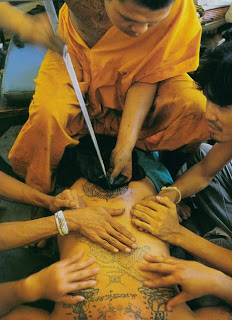
The traditional tattooing needle† has three interlocking parts: the head (the heaviest part) that usually resembles a nat (Burmese: spirit) or sacred animal; the middle section (hollow and holding the black or red ink) that makes up the largest part of the tool; and the tip (the ‘needle’ – narrow at both ends and flared in the middle), which may vary in size, but is usually the smallest component of the tool. When completely assembled, the entire needle, which is traditionally made from bronze but can be steel, aluminium or even bamboo (except for the needle), average lengths of 30-37cm (12-15 inches). The tool being used in the photos (right) is longer than most, but not exceedingly. During fieldwork, various sizes were visible, the shortest approximately 25cm (10 inches) and the longest nearing 60cm (24 inches). Although my research is incomplete, discussions with some spirit doctors revealed that longer needles allowed for better control and, as a result, more intricate tattoos.
†I use ‘needle’, though tool or implement might be a better description as the actual needle makes up only the tip of the implement.

The medium – the ink
The ink∫ is made from the soot of crude, peanut or sesame oil and lard that is collected from lamps and mixed with dried fish gall bladder before being tied up in a cloth to ‘ferment’. The soot is then mixed with a handful of leaves of boiled, bitter gourd in a large pot and boiled again. Next, the soot is removed and dried. In the final stage and just before use, the dried soot is mixed with boiled water or pure oil to form a thick paste. The ink is now ready for use, though some minor alterations, including mixing in limejuice and special herbs, can also be undertaken before the ink is applied in the tattooing process.
∫Traditionally, black ink was the only colour used for tattooing. Although my information is conflicting, the vast majority of tattoos are still produced in black ink only. However, I have heard that tattoos are increasingly using two colours: black ink, which is used for astrological drawings, red ink, which is used for religious purposes. If a red tattoo or red ink is selected, the spirit doctors will offer the nat coconuts, bananas and rice.

The task – tattooing
Now, the recipient of the tattoo enters the mandat (via the appropriate door), meets the spirit doctor and selects a tattoo. Although some friends and family are allowed to gather nearby to listen to the process, no one‡ is allowed into the mandat to watch, however, it is common for a young assistant to work with the spirit doctor, ferrying messages back and forth about the process’ progress to family and friends
‡ The only ones allowed to witness the tattooing were four close friends selected to hold the recipient of the tattoo down if required.

There is a hierarchy to the tattooing process that resembles the intent (minor or serious) of those wanting to be tattooed. Anyone who enters the mandat from the right entrance is usually tattooed by the lead tattooist initially (he will complete the main sections and outlines only), while the remainder (filling in or secondary design) will be completed by his understudy or understudies. It is commonplace for the lead spirit doctor to concentrate his efforts on clientele who entered from the left – those with serious tattoo requests – who require more detailed work and the highest skills.

Before the actual tattooing begins, the recipient of the tattoo prays to Buddha and promises to uphold the Five Precepts – not to kill, steal, lie, drink intoxicants or commit adultery. For serious clients, banana leaves are often spread on expensive silk blankets as the head tattooist chants prayers. Lastly, after the prayers and blessings are completed, the recipient of the tattoo must remain silent throughout a thorough procedure – he must emanate a composed and dignified aura – while he is stripped of his clothes (to be hung on the rope) and is subjected to a thorough leprosy and skin disorders examination. If no medical problems exist, the tattooing then commences.

Initially, the selected designs are marked on the skin with design blocks that have been cut and coated with sooty ink to create templates. Next, the outlines of the tattoo are etched into the skin, with leaves crushed and rubbed into the cuts afterwards, making the black ink turn a greenish black hue, which is considered more beautiful that pure black. If a traditional Shan waist-to-knee tattoo was selected, the spirit doctor would start at the waist, work around it, before proceeding downwards, tattooing one thigh at a time. Depending on the skill of the tattooist, one thigh, from waist to knee, would usually take about five hours; the tattooing starting at dawn to avoid the afternoon heat. The second thigh would not be done until later, often after consulting the recipient, though it is rare for anyone to have both thigh tattoos completed in less than a week. After the new tattoos were completed, assistants would wash the tattooed area with boiled water and herbs, to be repeated everyday by the tattooed person and/or family members, to ward off infection and aid healing. When everything was completed, the newly tattooed person would leave the hut and clap three times, a traditional Shan (and Burmese) display of manliness.

For more information, please visit the Sure Hope site (here) on Shan and animism or two independent traveller sites - Cameron in Sea or NineMSN.

Once again, thank you for visiting and mai soong kha.

Naw Liang