28 February 2010

Doomed by the hills: Why hill peoples wander Zomia stateless forever by Professor James C. Scott
By Naw Liang (London, United Kingdom)

Mai soong kha.
Inundated with work work and many other things not Shan, I have been eager to find something, anything Shan-related that I could sink my teeth into during those few stolen moments I manage to find each day. It's been tough work with few suitable results, though I am now set for Shan topics until at least next year (read: stay turned). Then, out of the blue, I found something - albeit a stretch - on the Shan by a well-known South East Asianist.

Enjoy.


Public Lectures and Events at the London School of Economics (LSE):
'
Why Civilisations Can't Climb Hills: a political history of statelessness in Southeast Asia' by Professor James C Scott (May 2008)
In May 2008, world renowned professor of political science and anthropology (specifically South East Asia) at Yale University (USA), James C Scott, gave a lecture at the LSE on a topic that, although not specific to the Shan, definitely focused on peoples like them in mainland South East Asia. Scott, a prolific and respected scholar on a range of subjects, including social/cultural anthropology, agrarian studies, subaltern studies, political and social capital as well as political science, is probably best known for his volume "
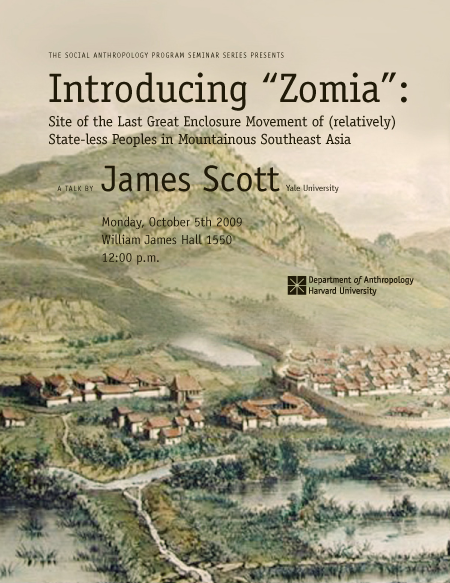
Seeing Like a State: How Certain Schemes to Improve the Human Condition Have Failed" (1999), a vade mecum for up-and-coming anthropology, political science and even development professionals, students and scholars. He has spent the past 40+ years studying the intricacies of mainland South East Asian peoples and politics. What I am certain will become his latest book, simply titled "Introducing "Zomia"" by Harvard University for a recent talk, Scott discusses the 'cleavage' created between plains and hill peoples in Zomia, a recent geographical term for mainland South East Asia that is governed by lowland peoples, such as the Thai, Burmese, Vietnamese and even the Chinese. Scott has spent the last decade researching this area and the interplay between lowland (and powerful) ethnic groups and their hillside (and less powerful) neighbours. It is heavy stuff, but highly thoughtprovoking.

Without giving away the secrets of the lecture, Scott's LSE event sought to provide some insight into the fundamental arguments and theories that he is currently working through as "Introducing "Zomia"" is completed. The talk, which you can listen to here, provided insight into the gamut of Scott's fantastic knowledge of South East Asian politics, history, anthropology and more. Although at times dense (reference, concept) and idiom-thick - Scott has a penchant for languages and enjoys sharing numerous 'sayings' throughout - the 80+ minute lecture and Q&A session is enlightening. In particular, I enjoyed his intriguing and supported belief that, rather than being shoved to the periphery by stronger groups through a variety of forces (slavery, war, cultural dilution and so on), hill peoples chose the border areas, most often inaccessible, to 'escape' through 'escape agriculture', 'escape social structure' and 'escape culture' to preserve themselves the only way that they could. Furthermore, Scott's theory that the sense of history for stateless people, such as the Shan, is simply the memory of struggle is truly sad, but fitting. I am sure that many of you, after chewing on the content, will start to see where Scott just might be coming from.

I look forward to reading the book: 1. (not if, but) when it's out and; 2. when I can find the time.

Jom lii kha,

Naw Liang

21 February 2010

Video: The Brooklyn Monk 'In Shanland'
by Naw Liang
(London, United Kingdom)

Mai soong kha.
The start of another year is fast fading from memory, and we are now safely and swiftly moving into spring or fall, wherever you might be. How time flies when you're.....

Some things, however, don't change, regardless of the new year or season: I remain as peripatetic as ever, sent here and there 'to work', but sadly never where I'd most like to be - Shan State. Moreover, there is little time left over to sit down, analyse, contemplate and, most important of all, compose for this or my research programme. But these are all excuses, nothing more.

Despite the barriers in my way, I (and we) can find solace in the wonders of the internet, which helps minimise my distance and absence from the Shan State, if only a little. It's nice (and less mentally taxing) to sit down late at night and scour the internet for information, interest and insight than thumb through another 500+ page tome, though the 'academic value' of net news doesn't always measure up to peer journals, scholarly papers and texts. But that is not their purpose, and we should remember that.

Recently, I have come across a very 'unique individual' and his even more intriguing Burma/Shan project. Antonio Graceffo, the Brooklyn Monk (see bio here; photo above is of Graceffo outside the Loi Tailang IDP camp on the Thai-Burma border), has been self-funding and self-producing a video series entitled 'In Shanland', amongst many others (see link to it and many other videos by Graceffo here), that has caught my eye. While I have made a concentrated effort to stay away from a variety of political issues - it has no place (in my mind) in social anthropological research - and Graceffo can be, at times, 'overly American' (read: prone to sensationalism), I enjoy the work he creates, if nothing more than to maintain my view of Shan State from afar.


Antonio Graceffo, The Brooklyn Monk, and Shan State in film
Over the past few years, Antonio Graceffo, American former investment banker, martial arts expert and, now, documentary film maker , has produced a series of videos on the Shan State that are loosely grouped under the title 'In Shanland'. The latest Shan-centred video by Graceffo, who is entirely independent, is 'In Shanland: Poppies and Oppression', which provides a firsthand look at a variety of issues and locales that few foreigners have been lucky enough to visit and document.
Its grainy images and gritty audio help add an air of mystique to the broadcasts.

I have to admit, I enjoy Graceffo's videos, if nothing more than as an escape from academia and a safe peek into some apparently 'off limits' areas of the Shan State. However, Graceffo's 'danger=cause' aura can overwhelm the important issues he focuses on in 'In Shanland', themes important for Burma and Shan enthusiasts alike. From poppy production to internally displaced people (IDPs), civil war and widows and orphans to medical missions (part I and part II), Graceffo manages to, at the very least, gain access to those directly involved, candidly discuss and records their thoughts, shedding light on these and other crucial issues to the Shan people. This videos, among several others (see links above) are projects that we should all see.

The obvious thrill-seeking thread that flows through much of Graceffo's work, however, is impossible to avoid
: from training (with) the Shan State Army (SSA) (his own hand-to-hand martial arts seminar to the frighteningly young, meek and, often, doe-eyed conscripts is shuddering at times); providing camouflaged 'peeks' at Burmese army (Tatmadaw) and United Wa State Army (UWSA) outposts; military discussions about trench systems; his overall bravado, complete with a SSA uniform and candids with weapons amongst many other clues. But there is one constant confusion that irks me the most. We are fully aware of his gungho attitude, but its over-the-top-ness raises innumerable questions - Why does he do this? To be involved in the conflict? To become a war correspondent? Why? - that poison his documentation beyond repair. Until we learn of his motives, this and other questions will take away any merit cultivated in the honest pursuit of knowledge about the Shan and Shan State in the first place. For now, let's hope that I am wrong and that Graceffo is merely an inquisitive, energetic and sympathetic soul - the alternative would merely be another downer.

Final thoughts
In the end and despite reservations about writing to 'promote' Graceffo's work, I decided that, as researchers, it is always better to have more information than less, regardless of the credibility, intention and outcome. While I (and some of you) may not approve of Graceffo's attitude, which could be considered arrogant (see some of his replies to comments about his videos),
and his modus operandi, Graceffo is, at the very least, making an effort, humping into somewhat difficult locales and actively engaging talks with those directly involved with and exposed to critical issues for the Shan. My advice is this: have a look at what he has produced, but, before dismissing his work it inevitably reaches 'questionable', engage with and question Graceffo (he is an active replier it appears) to learn more about his experiences. It may be fruitless, but it may also offer a window into another perspective that could be fruitful for your own research.

Jom lii kha,

Naw Liang